
Exterior-lighting field guide
Porch lanterns: wall, hanging, or post mount?
The mounting assembly defines the form. A wall lantern projects from a backplate and bracket, a hanging lantern descends from a ceiling canopy, and a post-top lantern seats on a standard or pier base. Each needs a different set of measurements before it can be identified or replaced confidently.
Name the complete assembly
Three mounting forms answer different conditions
| Form | Supporting hardware | Record first | Common fit question |
|---|---|---|---|
| Wall bracket | Wall plate plus a projecting arm or body support. | Backplate height and width; projection from wall to the body center and outer edge. | Will the plate cover the box and will the body clear trim, doors, and eaves? |
| Hanging lantern | Ceiling canopy with chain, links, or a rigid stem above the lantern. | Canopy diameter, body height and width, suspension length, and total installed drop. | Does the complete drop preserve headroom and keep the body within the protected porch area? |
| Post top | A bottom collar, base, or scroll assembly seated on a post, standard, or pier mount. | Base opening, outside base diameter, attachment method, body height, and widest spread. | Does the lantern base match the support and provide a secure route for the supply wiring? |
Dated comparisons
One 1927 catalog separates all three forms
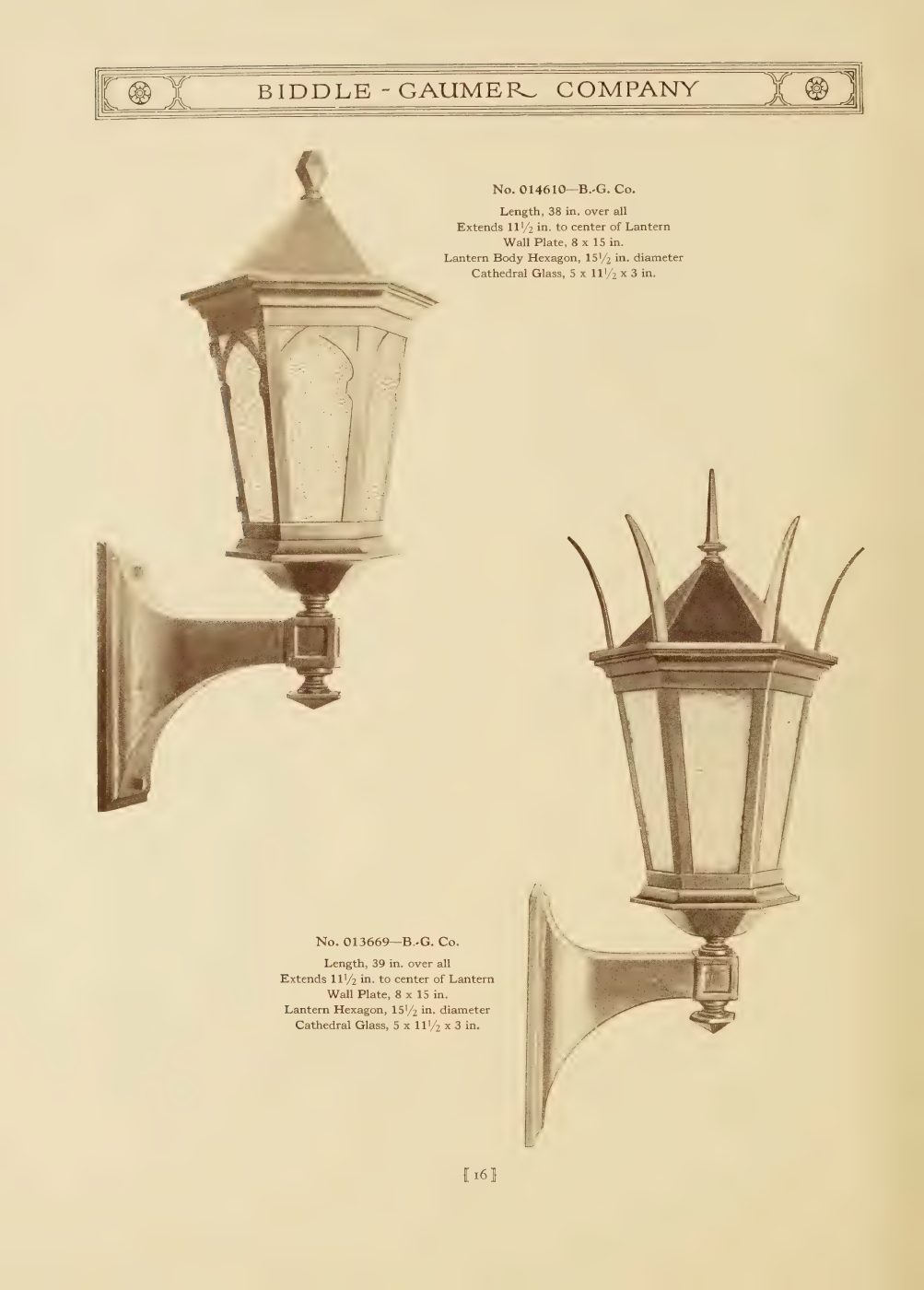
Biddle-Gaumer’s Exterior Lighting Fixtures, catalogue No. 19 organizes lanterns by their supporting assemblies. Its printed dimensions show why the lantern body alone is insufficient for a fit decision.
Wall bracket
The plate records overall length, projection to the lantern center, wall-plate size, body diameter, and individual glass-panel dimensions.
Inspect the catalog plate →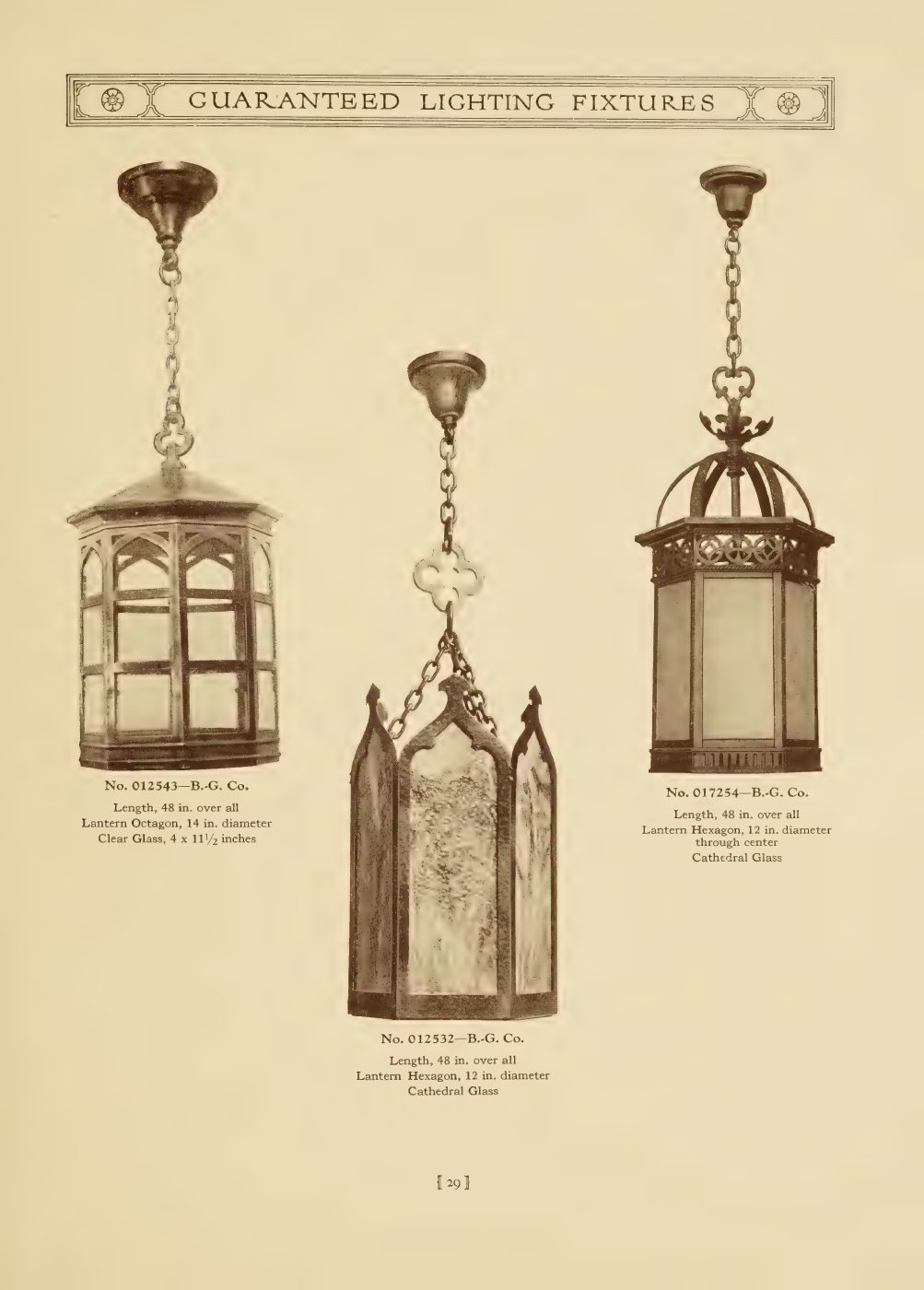
Hanging lantern
The catalog gives a 48-inch overall length for each example while separately identifying the lantern body diameter and glass.
Inspect the catalog plate →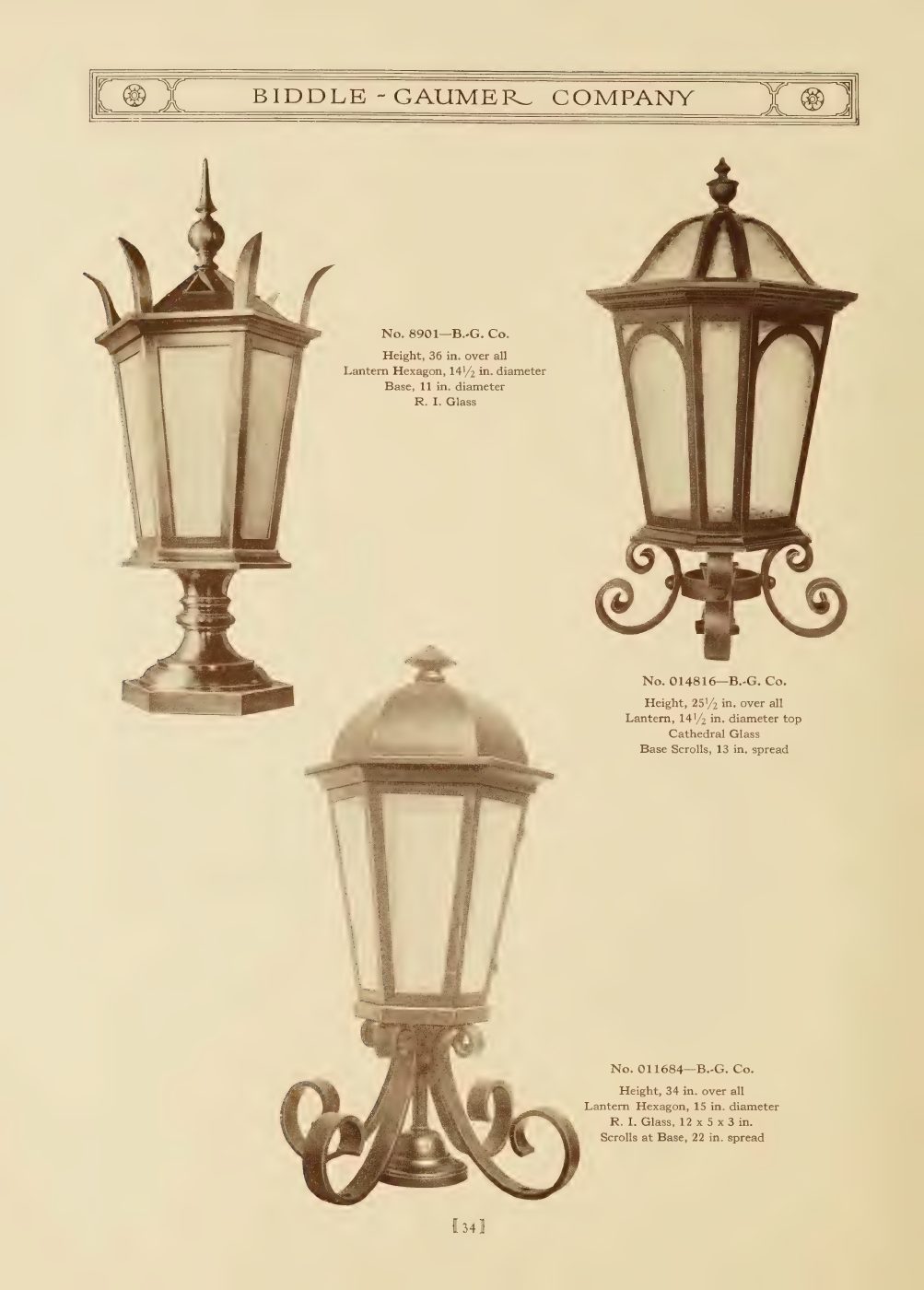
Post-top lantern
These examples list overall height, lantern diameter, and the base or scroll spread that meets the supporting standard.
Inspect the catalog plate →Measure the fixed support and the lantern separately
Photograph the fixture straight on, in profile, from below, and at the connection to the building or post. Place a ruler in the same plane as the part being measured. For a wall light, record both projection to the body center and maximum projection; the 1927 wall-lantern plate uses the centerline measurement, while modern listings may describe the outermost depth.
Record glass as its own component: panel count, visible opening, panel dimensions, texture, color, and how each piece is retained. Surviving glass and mounting hardware can be later replacements, so a similar body outline supports comparison without proving a maker attribution.
Include photographs of model numbers, foundry marks, labels, old fastener holes, and unused openings. An identification request is much easier to assess when those details accompany the overall views and measurements.
Outdoor installation
Check the location marking and mounting instructions
Current line-voltage outdoor luminaires are evaluated under UL 1598 with applicable wet- location requirements. Select a fixture whose marked location rating and installation instructions suit the actual exposure, and have questionable existing wiring, boxes, posts, or altered antique fixtures assessed by a qualified electrician. Review UL Solutions’ outdoor-lighting overview.
Current wall-lantern option
A reproduction with a clear bracket-mounted form
This current wall lantern has a tall enclosed body, seedy glass, and a visible bracket assembly that reads clearly beside the documented wall-mounted form. It is a modern Hinkley fixture, not a Biddle-Gaumer antique. Confirm its location rating, backplate, projection, finish, seller, price, and availability on Amazon before ordering.
As an Amazon Associate, Old House Lights earns from qualifying purchases. Prices and availability are shown on Amazon and may change.
Research sources
- Biddle-Gaumer Company, Exterior Lighting Fixtures: Standards, Post Lights, Lanterns, Bracket Lanterns, catalogue No. 19 (1927), scan positions 18, 31, and 36. Avery Architectural and Fine Arts Library, Columbia University Libraries; digitized by Internet Archive for the Building Technology Heritage Library. Open the complete catalog.
- UL Solutions, “Landscape and Outdoor Lighting,” current overview of outdoor luminaire categories and applicable safety standards. Open the UL overview.