
Archive field guide
How to read a historic lighting catalog
Start with the model number, then test the fixture form, dimensions, finish, shade, and mounting hardware against the same catalog entry. A close silhouette is a lead; matching construction and specifications are what turn it into useful identification evidence.
First establish what the catalog is
Trade catalogs are primary evidence of what a manufacturer offered, how it named products, and which specifications it considered important. The Library of Congress trade-catalog guide describes these publications as a visual record of commercial tastes and consumer trends. They document an offered product line, not every fixture installed in every house.
Before comparing objects, confirm the maker, exact title, date, holding institution, and whether the online item is complete. The catalogs in this archive come from the Avery Architectural and Fine Arts Library copy digitized by Internet Archive for the Building Technology Heritage Library. Each catalog page links back to that complete institutional scan.
Do not lose the page
Scan position and printed page are different
Covers, inserts, price lists, and blank leaves can shift the digital sequence. Old House Lights therefore labels the one-based image position as “Scan page.” A printed number visible on the paper should be recorded separately. Cite both when possible: for example, “Frankelite 1926, printed page 14, scan page 17.” That wording lets the next researcher find the same evidence without guessing which numbering system you used.
A repeatable reading order
Work from the identifier outward
Model or stock number
Copy it exactly, including prefixes and suffixes. Nearby fixtures can share ornament while differing in size, lamp count, or mounting.
Fixture and mounting form
Name what is visible: wall bracket, chain pendant, close-ceiling body, post lantern, socket cluster, canopy, arms, and shade holders.
Dimensions
Keep width, spread, depth, drop, projection, diameter, and glass size distinct. Catalog makers did not use those words interchangeably.
Finish and material
Preserve the maker’s exact wording. A named finish may describe a layered color treatment, not the base metal beneath it.
Shade, glass, and lamp count
Note what the catalog says was included and what the photograph shows. Surviving glass, sockets, and bulbs may have been replaced.
Price and ordering notes
Treat a printed price as evidence of the original offer only. It does not establish present value, rarity, completeness, or condition.
Read the whole plate
Four catalog layouts, four ways to find the data
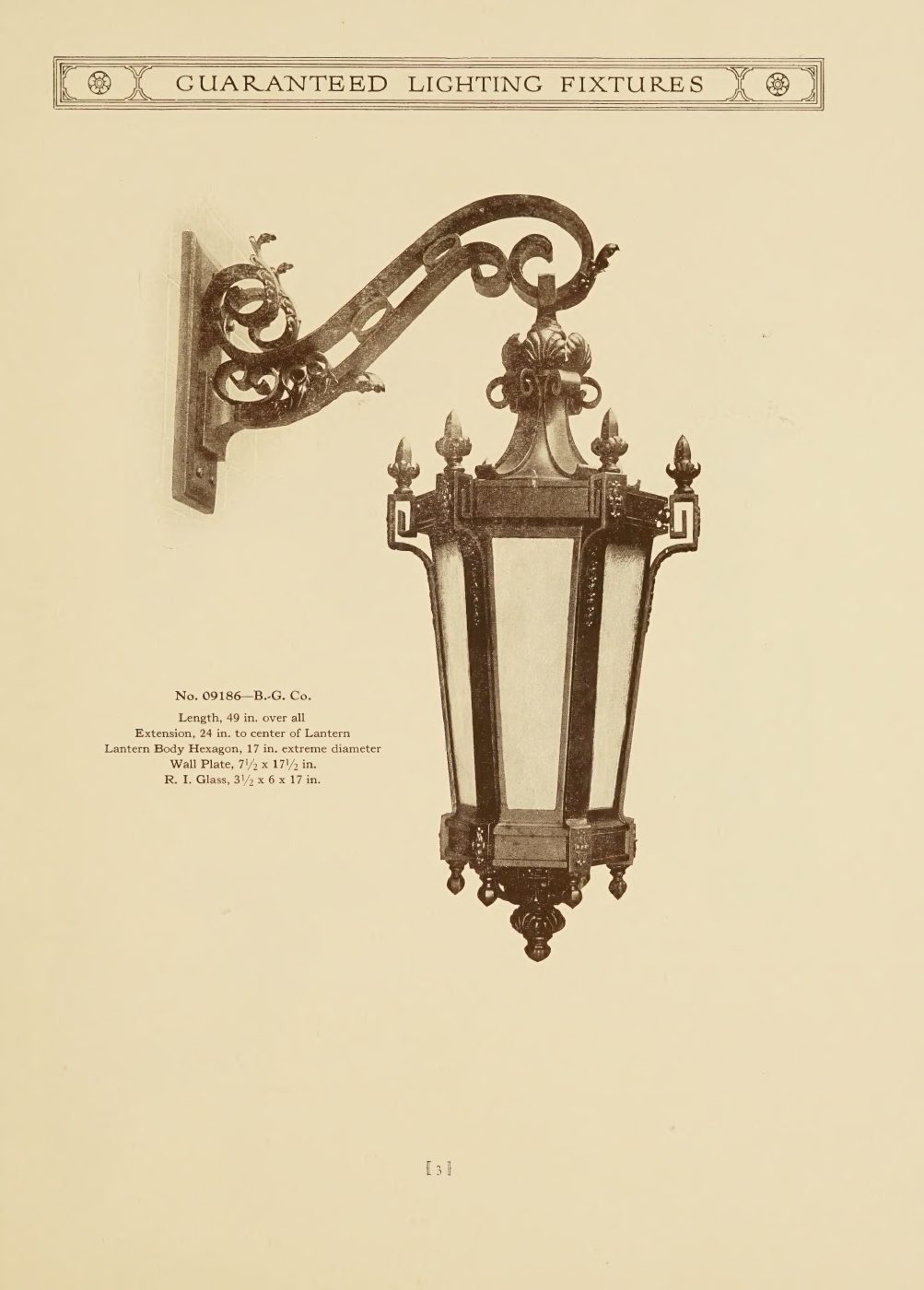
Biddle-Gaumer, 1927
Dimensions attached to one exterior model
The plate keeps the lantern, bracket, wall plate, extension, glass size, and model number together. Those relationships are more useful for identification than the general label “lantern.”
Open the cited scan page →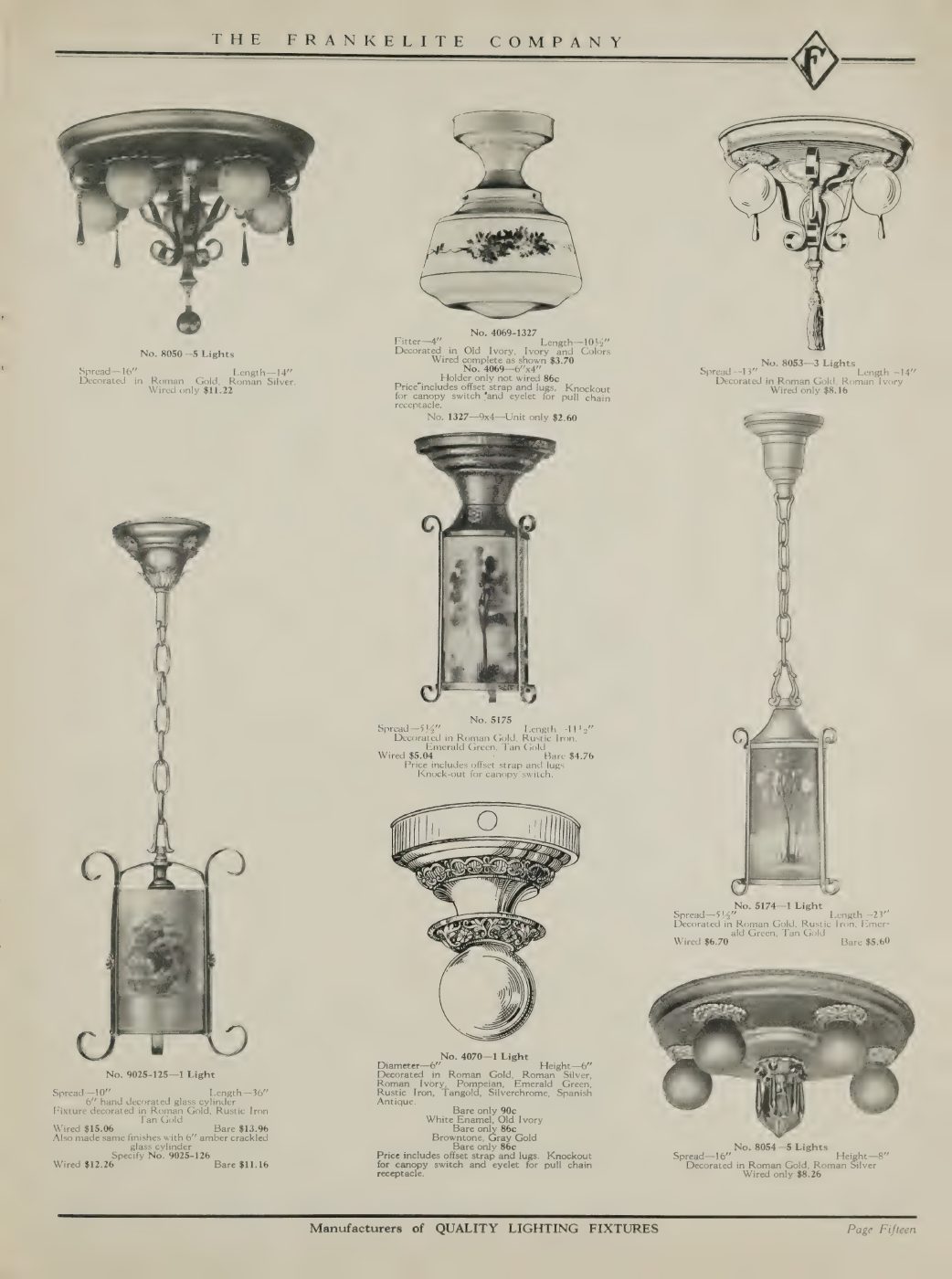
Frankelite, 1926
Several specifications on a mixed fixture plate
Each numbered fixture carries a compact description. Read the number, light count, dimensions, finish, shade, and price as separate fields rather than as one caption.
Open the cited scan page →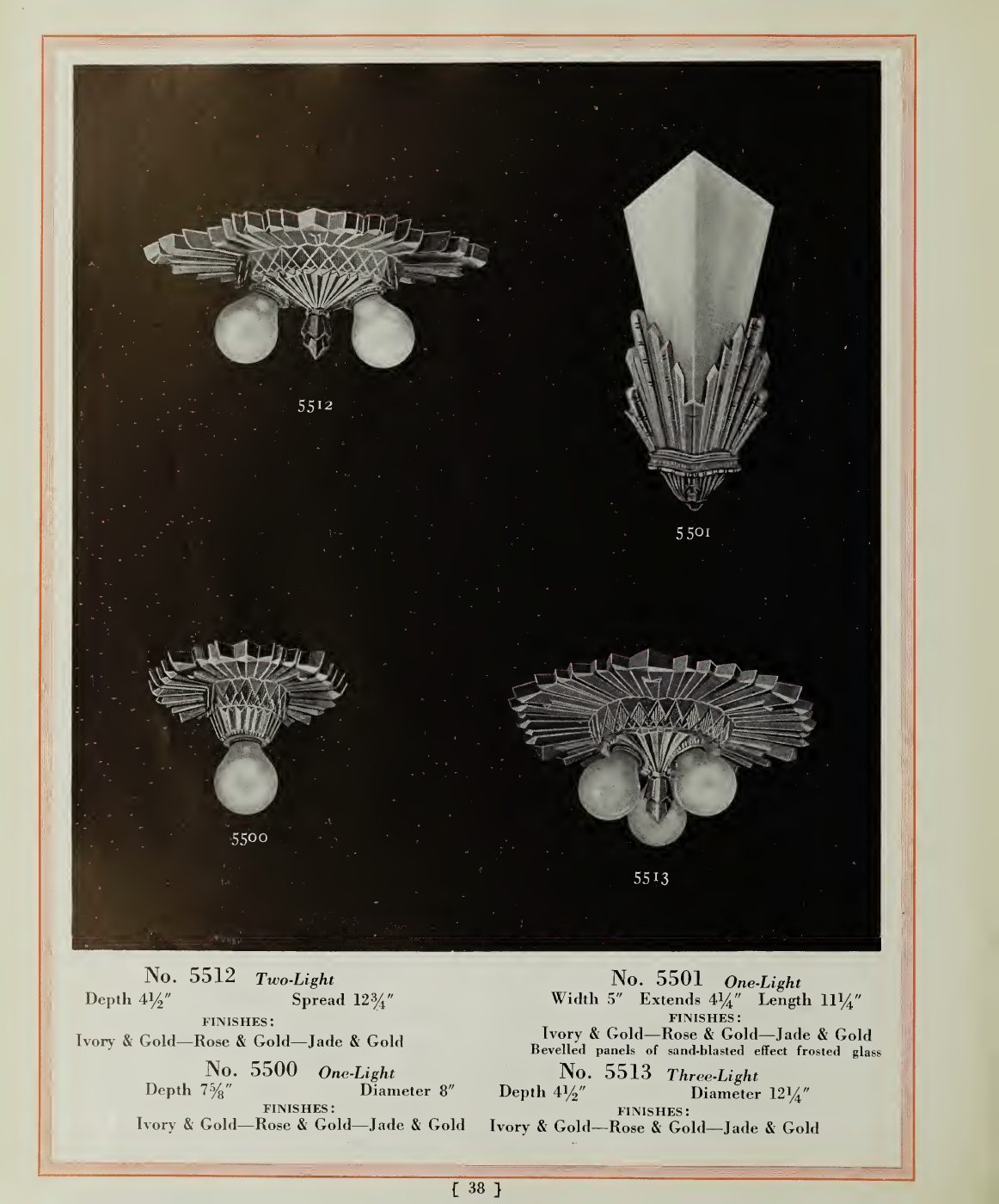
Champion, 1930
Finish names beside measured silhouettes
The maker distinguishes depth, spread, width, and diameter while listing several named finishes. Compare the same dimension to the same dimension on the surviving fixture.
Open the cited scan page →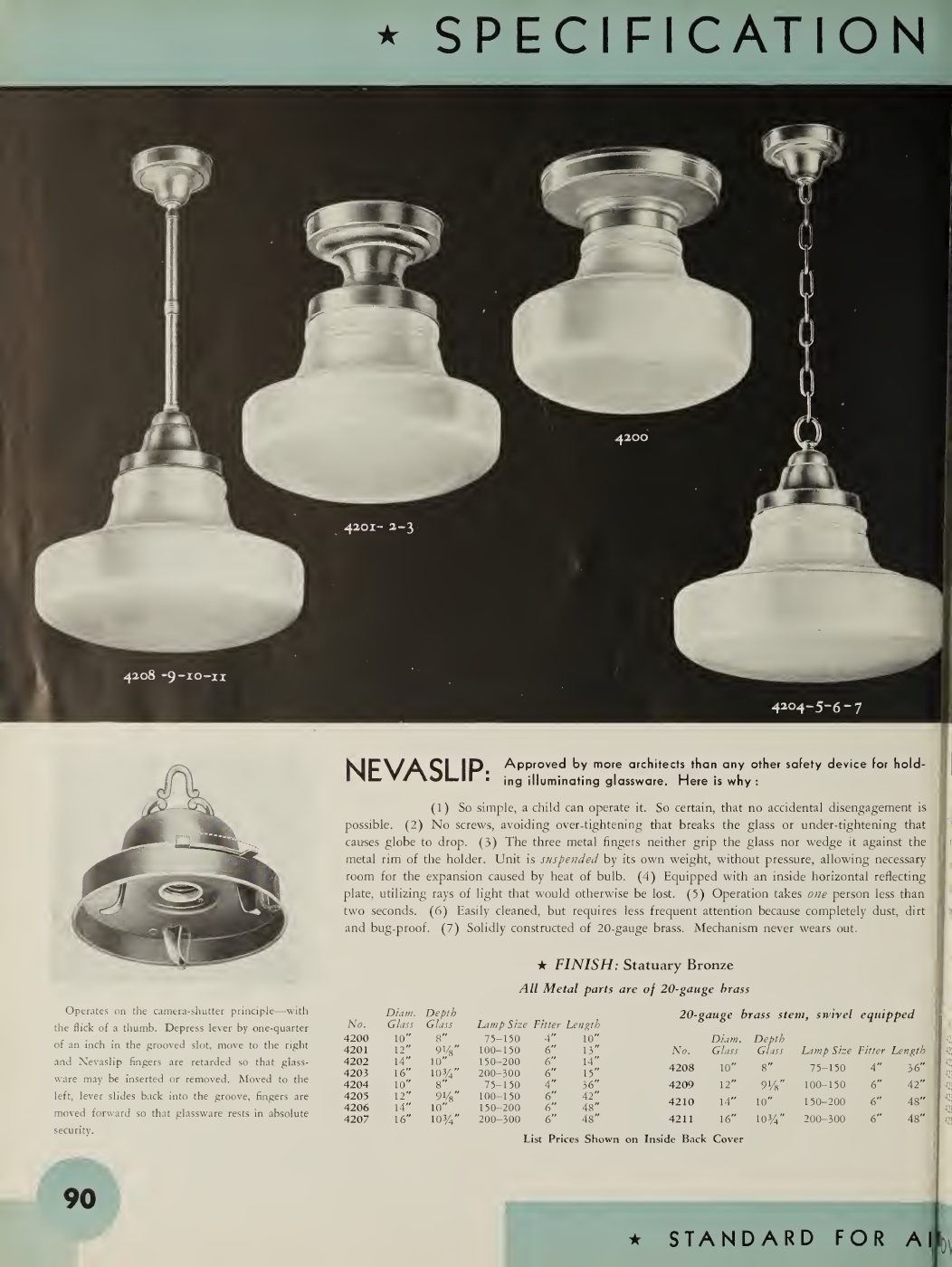
Lightolier, 1934
A specification table separated from the photograph
The product numbers printed near the photographs lead to the table below. A catalog may split the visual evidence and technical data across different parts of one page—or across several pages.
Open the cited scan page →Match evidence before naming a maker
An exact catalog match should agree on more than decoration. Compare arm count and direction, body proportions, canopy, mounting method, socket or fitter arrangement, dimensions, and small cast details. Check whether the supposedly matching part could be a later replacement. If a catalog shows several sizes, identify which one the measurement supports.
Use language that reflects the result. “Model 5512 appears on this 1930 Champion page” is appropriate when the identifying details match. “Consistent with Champion’s documented 1930 forms” is safer when the silhouette agrees but decisive details are hidden. If only the ornament resembles the page, call it a comparison—not an attribution.
Build a useful evidence note
Record what another person can check
Save the maker, catalog title and year, model number, printed page, scan page, stable source URL, compared dimensions, and every visible agreement or mismatch. Photograph the fixture from the same angle as the catalog image, then add close views of marks, canopy, sockets, fitters, and altered holes. Use the measuring guide for consistent dimensions or send the full record with an identification request.
Research sources
- Library of Congress, Trade Catalog Online Resources—institutional guidance on trade catalogs as primary visual records.
- Building Technology Heritage Library—the public research collection through which the catalog scans are available.
- Biddle-Gaumer, Exterior Lighting Fixtures (1927)—model and dimensional evidence for exterior lanterns.
- Frankelite, Lighting Equipment of Charm (1926)—fixture numbers, dimensions, finishes, shades, and prices on grouped plates.
- Champion, The Fourteenth Salesbook (1930)—measured silhouettes and named finishes.
- Lightolier, Style Book 1934–1935 (1934)—photographs keyed to a separate specification table.